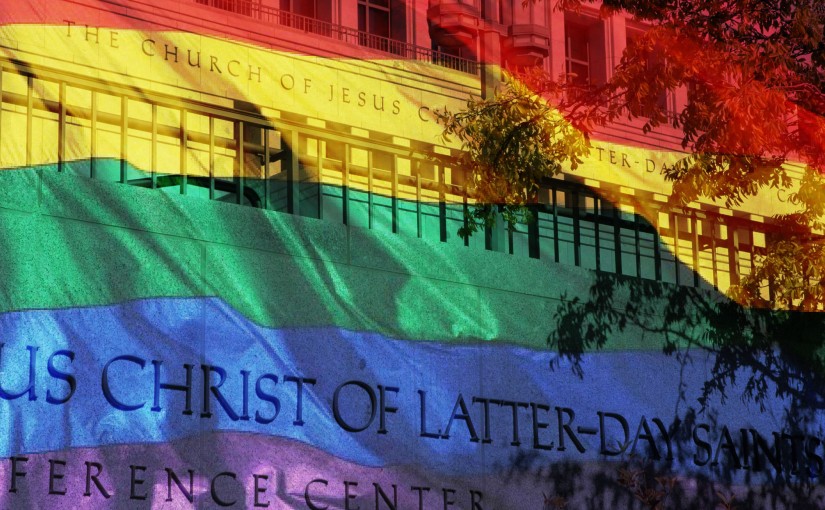
LGBTQ Policy Questioned in Local Media
“Our Thoughts” founder and frequent contributor, Kim Siever, was recently interviewed for a local media’s report on the Church’s new … Continue reading LGBTQ Policy Questioned in Local Media
Thought-provoking commentary on life, politics, religion and social issues.
“Our Thoughts” founder and frequent contributor, Kim Siever, was recently interviewed for a local media’s report on the Church’s new … Continue reading LGBTQ Policy Questioned in Local Media

At the start of the year, one of our Gospel Doctrine lessons touched on the Book of Mormon introduction. Of … Continue reading Is the Book of Mormon really the keystone of Mormonism?

When critics of a religion call out for change, one is tempted to question their motivation. The video below sets … Continue reading What LDS Women Get?

This is a guest post written by Holly Whitman and is American-centric. Holly is a freelance writer and journalist, originally from the UK but now based in Washington DC. You can find her on Twitter at @hollykwhitman and more of her writing on her blog, Only Slightly Biased. To submit a guest post, email ourthoughts@gmail.com.
For the longest time, the most pressing issue about public restrooms was the mere fact that there often weren’t enough of them. This is especially true at concert and stadium venues, where the lines can stretch several hundred feet. Now, with the emergence of people identifying as transgender, the issue of restroom accommodation is taking on a whole new spin.
Will it become a legal requirement for a public building to require a men’s bathroom, a women’s bathroom and a non-gender-specific bathroom? And what about churches? Will they be required to expand their restroom facilities even if there is little chance of transgender members becoming a part of their community? Could this all be a case of political correctness run amuck? Clearly, there are a lot of factors to sort through when it comes to the bathroom question. Continue reading “Gender neutral bathrooms: a legal requirement, or will your church be exempt?”

The following blog post was submitted anonymously by an active Latter-day Saint who serves in a leadership calling in their … Continue reading 7 secular reasons why I’m still religious
This is a guest post written by Holly Whitman. Holly is a freelance writer and journalist, originally from the UK but … Continue reading Why you should support charitable organizations outside your church

In our elders quorum class today, we were discussing chapter 5 in the Howard W. Hunter Manual: Joseph Smith, Prophet of the … Continue reading Joseph Smith and the democratization of religious worship
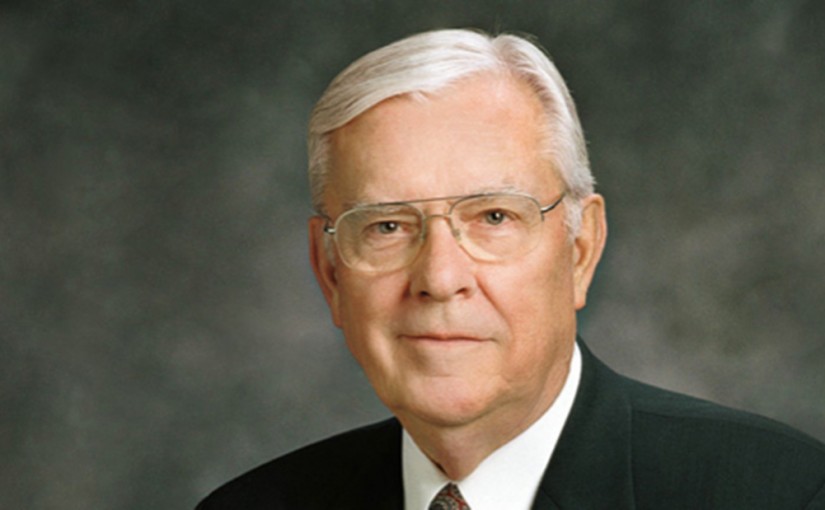
Last night, in a devotional directed at Church Educational System (CES) employees, Elder Ballard spoke of challenges that many youth face, including questions asked on social media.
(Kids these days and their FaceSpace, amirite?)
From a Deseret news article about Elder Ballard’s talk:
“Drawing on the scriptures and the words of the prophets, [students] will learn how to act with faith in Christ to acquire spiritual knowledge and understanding of His gospel,” he said. “And they will have opportunities to learn how to apply the doctrine of Christ and gospel principles to the questions and challenges they hear and see every day among their peers and on social media.”
Applying the doctrine of Christ to questions of church doctrine makes sense. Is it true and is it helpful? Does it follow the golden rule?
Elder Ballard continued, comparing faithful interpretations of history to vaccinating the youth against topics that are “sometimes misunderstood” — a polite way of saying, negative toward the church.
You know, we give medical inoculations to our precious missionaries before sending them into the mission field, so they will be protected against disease that can harm and even kill them. In a similar fashion, please, before you send them into the world, inoculate your students by providing faithful, thoughtful and accurate interpretations of gospel doctrine, the scriptures and our history, and those topics that are sometimes misunderstood.
And in a praiseworthy show of transparency, Elder Ballard listed a few topics which in some circles (or at least in the not so distant past) would have been considered anti-mormon.
To name a few of such topics that are less-known or controversial, I’m talking about polygamy, and seer stones, different accounts of the first vision, the process of translation of the Book of Mormon [and] of the Book of Abraham, gender issues, race and the priesthood, or a Heavenly Mother. The efforts to inoculate our young people will often fall to you CES teachers.
Perhaps if I’d been further inoculated as a youth, I wouldn’t have found these topics so difficult to digest when I finally found them too hard to swallow. So roll up your sleeves while I share with you what I remember being taught about this list while at the same time you’re going to get inoculated.
Before you run off searching high and low looking for how far the rabbit hole goes, Elder Ballard warned of the dangers of access to too much information:
It was only a generation ago that our young people’s access to information about our history, doctrine and practices was basically limited to materials printed by the church. Few students came in contact with alternative interpretations. Mostly, our young people lived a sheltered life. Our curriculum at that time, though well-meaning, did not prepare students for today — a day when students have instant access to virtually everything about the church from every possible point of view. Today, what they see on their mobile devices is likely to be faith-challenging as much as faith-promoting. Many of our young people are more familiar with Google than they are with the gospel, more attuned to the Internet than to inspiration, and more involved with Facebook than with faith.
For the sake of Elder Ballard’s concern about Google, I’ll only use church approved sources for the inoculation and I’ll stay far away from Facebook.
“Cutting off the nose to spite the face” is an expression used to describe a needlessly self-destructive over-reaction to a … Continue reading Cutting Your Nose to Spite Your Face
Last night I bumped into an LDS acquaintance I hadn’t seen in years. He asked me what ward I lived … Continue reading If You Can’t Beat Them, Kick Them out